


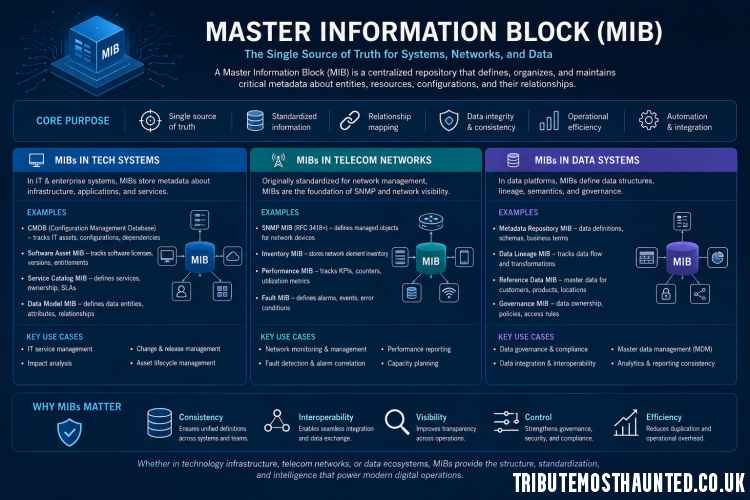
In modern computing and telecommunications, the Master Information Block (MIB) is one of the most critical concepts behind system startup, synchronization, and data organization. Whether it’s a 5G smartphone connecting to a mobile tower, a SQL Server database booting, or a mainframe tracking source code versions, the MIB acts as the foundational layer that tells systems how to operate.
In 2026, the term Master Information Block appears across telecom engineering, enterprise databases, knowledge management platforms, and ERP systems. Despite the different industries, the idea remains the same: the MIB is the gateway that unlocks access to everything else.
What Is a Master Information Block?
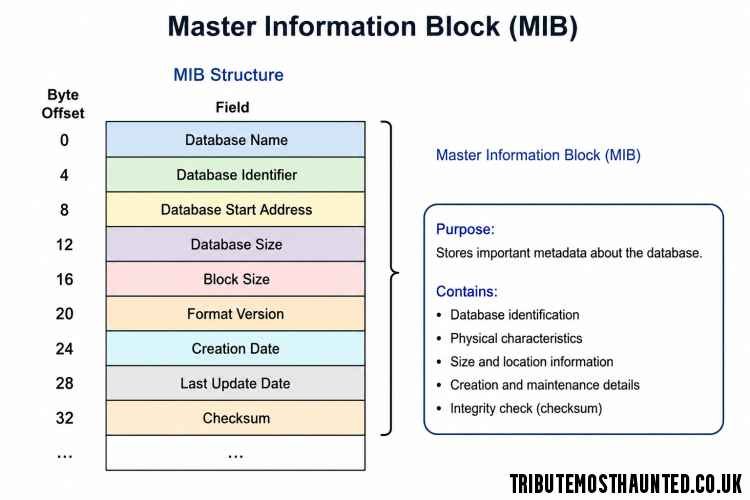
A Master Information Block is the first and most essential set of information required for a system to initialize, connect, synchronize, or organize itself.
At its core, the MIB provides:
- Basic configuration data
- System synchronization information
- Pointers to additional data
- Critical startup instructions
Think of it like the front page of a map. It doesn’t show every street, but it tells you where to begin.
In telecom, the MIB helps devices connect to networks. In SQL databases, it stores system-level metadata. In enterprise software, it controls how records and configurations interact.
Master Information Block in 4G LTE and 5G NR
The most widely recognized use of the term is in LTE and 5G mobile networks.
What Does the MIB Do in LTE and 5G?
When a smartphone powers on, it initially knows nothing about nearby cellular networks. The device first scans for:
- PSS (Primary Synchronization Signal)
- SSS (Secondary Synchronization Signal)
After synchronization, the phone searches for the Master Information Block.
The MIB is the first broadcast message transmitted by the network. It provides the minimum data necessary for the User Equipment (UE) to continue accessing deeper system information.
Without decoding the MIB, the device remains effectively:
- Disconnected
- Unsynchronized
- Unable to access SIB1
- Blind to network configuration
This is why engineers often call the MIB the network’s “digital welcome mat.”
Key Parameters Contained in the MIB
In LTE and 5G systems, the MIB includes critical information such as:
| Parameter | Purpose |
|---|---|
| Downlink bandwidth | Defines available PRBs (6, 15, 25, 50, 75, 100) |
| PHICH configuration | Specifies HARQ acknowledgment settings |
| System Frame Number (SFN) | Synchronizes device timing |
| Number of antenna ports | Supports MIMO operations |
| SIB1 pointers | Guides UE to deeper system information |
The MIB travels through:
BCCH → BCH → PBCH
This transmission chain ensures every nearby device can reliably receive startup instructions.
LTE vs 5G NR MIB Differences
In 5G NR, the MIB has evolved for:
- Flexible spectrum use
- Massive MIMO
- Advanced beamforming
- Dynamic frequency structures
The 5G MIB remains lightweight but contains highly optimized pointers that allow devices to navigate a far more complex radio architecture.
Important transmission details:
- Repeats every 40 ms
- Full decoding cycle spans 80 ms
- Sent in subframe #0
- Retransmitted every 10 ms
COBOL Element Master Information Block
Outside telecom, the term also appears in mainframe development and COBOL source management.
How the COBOL MIB Works
In COBOL systems, the Element Master Information Block functions as a metadata control structure for source code elements.
It tracks:
- Source code versions
- Insertions and deletions
- User modifications
- Timestamps
- Element identifiers
Important COBOL MIB Fields
Key data fields include:
| Field | Purpose |
|---|---|
| SRC-ELM-LENGTH | Size of the MIB block |
| SRC-ELM-BLOCK-ID | Usually “$ELM” |
| SRC-ELM-ELEMENT-NAME | Name of the code element |
| SRC-ELM-ELEMENT-VERSION | Current version number |
| SRC-ELM-NUMBER-INSERTS | Count of added statements |
| SRC-ELM-BASE-DATE | Audit timestamp |
This structure allows enterprises to maintain:
- Version control
- Code auditing
- Mainframe integrity
- Historical tracking
In heavily regulated industries like banking and insurance, this type of MIB remains indispensable in 2026.
SQL Server Master Database: The Core Information Block
In Microsoft SQL Server, the master database functions similarly to a Master Information Block for the entire database instance.
Why the SQL Master Database Is Critical
The SQL Server master database stores:
- System configuration settings
- Login accounts
- Linked servers
- Database locations
- Initialization metadata
Physical files include:
- master.mdf
- mastlog.ldf
Without these files, SQL Server cannot start.
This makes the master database one of the most important assets in enterprise infrastructure.
What Happens If the Master Database Fails?
If the master database becomes corrupted:
- SQL Server startup fails
- System-wide metadata becomes inaccessible
- User databases cannot load
- Recovery operations become mandatory
That’s why administrators treat the master database as the single source of truth for the SQL environment.
Knowledge Blocks and Content Management Systems
The Master Information Block concept also appears in knowledge management platforms.
ServiceNow Knowledge Blocks
In ServiceNow, reusable content blocks allow organizations to:
- Create content once
- Reuse it across multiple articles
- Update all linked articles automatically
This creates consistency while reducing duplication.
Moodle Blocks
In Moodle LMS systems, blocks serve as modular information containers such as:
- Navigation panels
- Course tools
- Announcements
- Upcoming events
These “master blocks” improve user experience and centralize management.
The principle remains identical: one authoritative information source updates everything downstream.
Enterprise Systems: Oracle and SAP Master Blocks
Enterprise resource planning systems also rely on master information structures.
Oracle OPERA Master and Sub Blocks
In hospitality management, Oracle OPERA uses:
- Master Blocks
- Sub Blocks
These organize group reservations across pricing categories and room types.
For example:
- 10 staff-rate rooms at $99
- 100 convention-rate rooms at $200
When synchronization settings are enabled, updates to the master block automatically propagate to sub blocks.
SAP Customer Master Blocking
In SAP SD systems, organizations can block customer master records to control:
- Sales orders
- Billing
- Deliveries
- Business relationships
This “master control” function ensures downstream systems follow centralized business rules.
Why Master Information Blocks Matter in 2026
The concept of the Master Information Block exists because modern systems are incredibly complex. Every platform needs a reliable way to:
- Initialize operations
- Synchronize components
- Maintain consistency
- Reduce duplication
- Guide deeper processes
Here’s how MIBs function across industries:
| Domain | Role of the MIB |
|---|---|
| 5G/LTE | Enables initial network access |
| COBOL | Controls source version tracking |
| SQL Server | Stores instance-wide metadata |
| Knowledge Platforms | Centralizes reusable content |
| ERP Systems | Synchronizes records and workflows |
No matter the platform, the MIB is always:
- The first thing read
- The core authority
- The gateway to deeper functionality
FAQs About Master Information Block
What is the Master Information Block in LTE?
It is the first system message broadcast by an LTE network. It provides synchronization and configuration data required for a device to access deeper network information.
What does the MIB contain in 5G NR?
The 5G MIB includes synchronization data, bandwidth details, and pointers to SIB1 for flexible spectrum and beamforming support.
Can SQL Server run without the master database?
No. SQL Server cannot start if the master database is missing or corrupted because it stores all system-level metadata.
Why is the MIB important in telecom?
Without decoding the MIB, mobile devices cannot connect, synchronize, or access network services.
Is the Master Information Block only used in telecom?
No. The concept also exists in databases, enterprise software, COBOL systems, ERP platforms, and knowledge management tools.
Final Thoughts
In 2026, the Master Information Block remains one of the most important hidden foundations behind modern digital infrastructure. From 5G smartphones and mainframe computers to SQL databases and enterprise systems, MIBs ensure technology can initialize, communicate, and stay organized.
Understanding the MIB means understanding how systems truly start, connect, and maintain consistency in a world powered by data.